In the bustling rhythm of modern life, it’s easy to overlook the basics of self-care. You might find yourself focusing on the latest health trends or fitness routines, yet there’s one crucial element that deserves more attention: water. It’s something you consume daily, yet you might not fully appreciate its significance. Let’s dive into why water is so essential, how it supports various bodily functions, how much you need, and the transformative benefits it offers. I’ll also share my personal journey of how drinking 2 liters of water a day has changed my life.
Table of Contents
DISCLAIMER: The amount of water you need differs per person, per circumstances, per activity. I am not medically trained to give you medical advice, this is just my perspective on drinking water and all the processes in your body.
Why do you need water?
Water is an essential element to your existence. Comprising about 60% of your body weight, it is involved in nearly every bodily function. Without it, your system cannot perform optimally. Here’s why water is so critical:
- Cellular Function: Every cell in your body relies on water to carry out its functions. It facilitates the transport of nutrients and the removal of waste, ensuring that cells remain healthy and efficient.
- Regulation of Body Temperature: Water helps regulate your body temperature through sweating and respiration. It acts as a coolant, maintaining your internal environment at a stable temperature, whether you’re exercising or just going about daily activities.
- Digestion and Absorption: Water is necessary for digestion. It helps break down food, allowing your body to absorb essential nutrients and move food through your digestive tract. Without enough water, you might experience issues like constipation or poor nutrient absorption.
- Detoxification: Your kidneys filter waste products from your blood and excrete them through urine. Adequate hydration supports this process, helping to flush out toxins and maintain kidney health.
- Joint Lubrication: Water is a key component of synovial fluid, which lubricates your joints. This prevents friction and reduces the risk of joint pain and stiffness.
- Better Brain Function: your neurons in your brain sends signals, which are electrical, which needs water and electrolytes.
You don’t only drink water for the water, but also for the electrolytes. Electrolytes are important for cellular function and performance and they are essential for monitoring and regulating hydration levels.
Where is water stored?
What’s interesting that not many people know what happens with the water they drink, so I did my research to learn myself and you.
- Intercellular storage: inside your cells, 2/3 of your water is stored intracellular: most of your water is going to be in the cells of your brain, heart, lungs, kidneys and so on.
- Extracellular storage: outside your cells, 1/3 of you water is stored outside your cells in your connective tissue which includes interstitial fluid (fluid between cells) and blood plasma.
Different types of thirst and different types of dehydration:
- Intercellular thirst: If your cells get dehydrated then simply drinking water can be enough to replenish them
- Extracellular thirst: If you lose blood, for example, you need salt and water. This could mean that you might need a meal with you water to quench your thirst.
Keep this in mind, as you will see the connection as to why it is interesting to know this.
How does your brain and body monitor hydration levels?
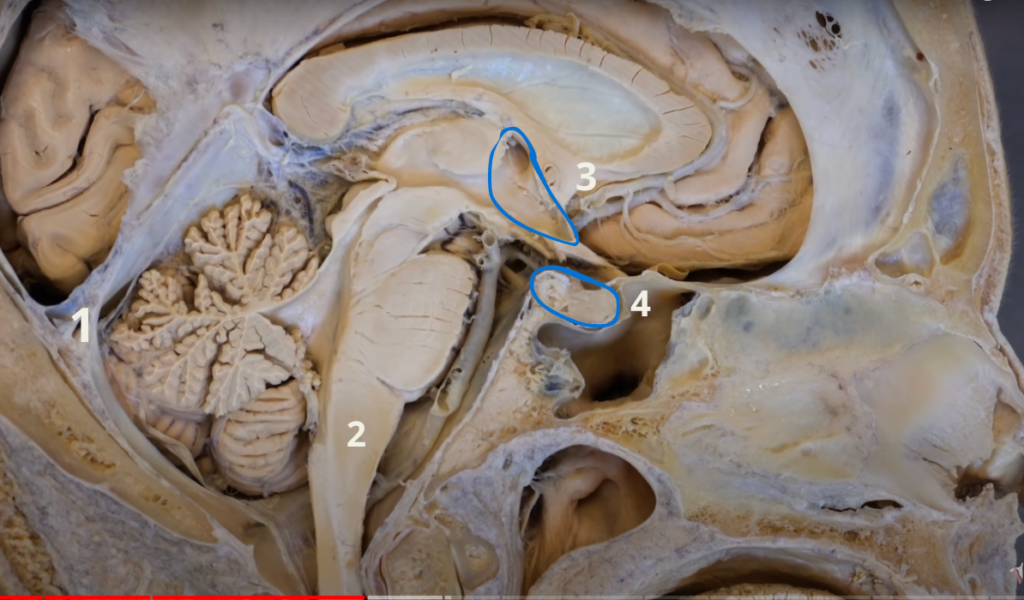
1. Cerebellum
2. Brain stem
3. Hypothalamus
4. Pituitary gland
Your brain and body work together to regulate hydration levels through a complex feedback system.
Your Hypothalamus (3) and Pituitary gland (4) form a bridge between the neurological system in your brain and your glandular hormonal endocrine system (like your adrenal glands, which is responsible for the hormones in your body).
So the Hypothalamus communicates what your body needs and then your pituitary gland sends out signals. These needs are base around Homeostasis: think of this as your body’s natural balance, your body being as closed to balanced.
The job of your Hypothalamus is to keep the body close to Homeostasis or just away from Homeostasis, but this depends on the circumstances, like body temperature. So if you’re going hot because of a work-out your Hypothalamus will start your sweating system to help the body cool down and get closer to Homeostasis.
So your Hypothalamus is also responsible for your water-regulation: Osmoregulation. To understand Osmoregulation you need to understand Osmosis.
Osmosis is simply put the diffusion or movement of water from one area to another based around electrolyte concentration. Electrolytes are things like sodium, chlorine, potassium, magnesium, calcium etc; these are all over your body.
Electrolytes are important for cellular function and performance and they are essential for monitoring and regulating hydration levels.
So in your Hypothalamus are cells which are called Osmoreceptors, these are stretch-sensitive neurons: they are capable of determining how much electrolytes are overall in the body based around how much water and electrolytes are inside of them.
So, if there is not enough water these Osmoreceptors will actually shrink and they will send a signal to your posterior pituitary (based on the left top of your pituitary gland). The osmoreceptors will tell it to give off a hormone to your kidneys: the anti-diuretic hormone (anti-urinate hormone). In this way your kidneys will know that they shouldn’t let water get out of the body, in other words; not to urinate.
And, if there is too much water in your body, your osmoreceptors will start to swell. This will also send a signal to your posterior pituitary which will be to make less anti-diuretic hormone. If your body makes less of this hormone, you will urinate more and lose more water.
It’s all about balance in your body: Homeostasis.
Osmoreceptors aren’t the only ones in the body monitoring hydration, they are part of your osmoregulation. There are also other neurons which are responsible for yoour osmoregulation, like Baroreceptors, located inside your blood vessels, specifically arteries, like your aorta.
They are monitoring blood pressure. There is water in your blood, so if you have too much water in the blood stream, that’s going to elevate blood pressure.
These Barorecpetors are also stretch-sensitive neurons. They are going to detect the high blood pressure and then they will initiate a series of events, that’s going to be osmoregulative.
So let’s say you get a cut, you’re bleeding, you’re now losing water, which gives you a slight decrease in blood-pressure. Your Baroreceptors are also going to sense that and they will start your osmoregulation mechanisms.
Your kidney filters your blood and the unfiltered blood will be led there by the Renal artery. The renal artery splits into many different tiny arteries which will come out at the renal cortex of your kidney, where many interesting processes happen. There are little filtration units located (which you can’t see), called: Nephrons. They will filter the blood and it will go out of your kidney through the Venal artery.
When the Nephrons filter out the waste they will drop it in the Renal Medulla (collecting tubes), this is made up of individual renal pyramids (darkened porrtions). The renal pyramids will drop out the waste into the urinary tract, which will go down to the ureter and down to the bladder.
The Osmoregulation is going to occur in the Renal Medulla. Side note to understand: the tissue of the kidney is naturally salty, it has a bunch of sodiums and chlorides inside of it. That is going to attract water.
So if you have too much water, your kidney will put the salt into the collecting tubes and that will attract water into the renal pyramids. Then you will urinate out the excess water.
Now, if you are dehydrated: the salt will move deeper into the kidney tissue and the water will come with it. The water will go into the tissue where it will find more other accessory blood vessels, which will be returned to the body through the venal artery. Then your baroreceptors will notice this change in your blood.
How much water do you need?
The commonly recommended amount is eight 8-ounce glasses of water a day, equating to about 2 liters or half a gallon. However, individual needs vary based on factors like age, weight, activity level, and climate. A general guideline is to drink enough so that your urine is pale yellow. Dark urine is often a sign of dehydration.
Your kidneys monitor your hydration level the most: they will send a signal to your brain if you need to drink water, so you can also just follow your thirst feeling.
For me, this doesn’t work that well, because I’ve neglected my thirst for years on end. So I try to follow my 2 liters a day, from which I notice positive impact, BUT YOU DON’T NECESSARILY HAVE TO: WATCH THIS VIDEO.
In the beginning of starting to hydrate the right way, this is not something you should focus on. First, focus on implementing the habit of drinking water. Then start taking in account the exact amount you need based on your individual circumstances.
That’s true of health and wellness in general. If you want to make an overall improvement of yourself, you first need to educate yourself as to why it is important and why it is a good idea to make that improvement. And second, you need to build a healthy habit off of that and then you can even start to expand later down the road.
The amount of water you need differs per person and this depends on a variety of factors:
- The altitude that you live at
- How old you are
- If you are menstruating or not
- Do you drink alcohol
- How physically active you are
- etc etc.
There are different types of hydration:
- Euhydration: having a normal/adequate amount of water for normal physiological processes to happen. Then your water and electrolytes are balanced and they are in the places they need to be in: the interstitial (tissue between cells and organs), intravascular (inside blood vessels) and intracellular (inside cells).
- Hyper-hydration: having an excessive amount of water beyond the normal state of hydration.
- Hypo-hydration: having an insufficient amount of water below the normal state of hydration.
We all use the term dehydration instead of hyper-, or hypo-hydration. BUT, there’s a difference. Dehydration is the process of moving from a state of euhydration to a state of dehydration.
Either way, we all want to stay away from such big dehydration that brings us to a state of hypo-hydration.
How do you lose water?
There are 2 forms of water loss sensible (water loss that you would notice) water loss and insensible water loss (you are not aware that you are losing water).
Your insensible water loss consists of about 1 liter per day. This can increase in environments that are more dry or cold or even through increased breathing levels during work-outs.
You lose water through several ways:
- Urinating (normally about 1,5 liters per day) or feces(normally about 100 ml per day)- sensible
- Sweating – sensible
- Crying – sensible
- Bleeding – insensible
- Breathing – insensible
- Speaking – insensible
Essentially people lose about 2.7 liters of water per day, again this differs for everyone. This consists of 1 L of insensible water loss, 1,5 L of urinal loss, 100 ML loss to sweat, 100 ML loss to feces.
So you’d say you should drink 2,7 L of water per day. This is not particularly this way: it’s been said that 20-25% of your water intake is from eating a balanced meal. So drinking a little bit over 2 L per day is a good way to get hydration.
You are not just losing water, but you are also losing electrolytes, these salts are what attract water to it. This will both alter and affect your osmoregulation pathway.
Dehydration has two forms: dehydration of water and dehydration of electrolytes, it can also be both.
Dehydration is going to affect the performance of the cells. How much it affects the performance depends on the kind of dehydration.
Dehydration symptoms are: headache, dry mouth, dry lips, dry eyes, dry skin, darker color of urine, confusion, fatigue. The bigger your hydration is, the worse your symptoms will get. So essentially, dehydration is making your body die very slowly.
How to optimize your water intake?
To make sure you’re drinking enough water, consider these tips:
- Carry a Reusable Water Bottle: Having water within reach makes it easier to sip throughout the day.
- Set Reminders: Use apps or set alarms to remind you to drink water regularly.
- Infuse Your Water: Adding fruits or herbs can make drinking water more enjoyable and encourage you to drink more.
- Monitor Your Intake: Track your water consumption to ensure you’re meeting your daily goals.
- Eat Water-Rich Foods: Incorporate fruits and vegetables with high water content, like cucumbers, oranges, and strawberries, into your diet.
Keep in mind one size fits one! It’s different for everyone.
When you want to find out how much water you personally need, you can start in this way.
Drink an excess of water to get to a state of slight or mild hyper-hydration.Then the body can take what is needed to maintain fluid and electrolyte balance an then the kidneys can get rid of the excess. Don’t overdo the hyper-hydration, this can have harmful effects on your heath!
Take/eat electrolytes on top of your water to optimize your hydration levels.
This is for someone that doesn’t work out a lot and who isn’t in a hot or humid environment.
Start with 3 liters: 1 L of insensible water loss, 1,5 L of urinal loss, 100 ML loss to sweat, 100 ML loss to feces, 300 ml for hyper-hydration.
This is for someone who does exercise, keep in mind that your water intake also depends on the intensity of the work-out.
During exercise most people can only absorb 1 liter of water per hour. But with a high intensity people can lose over 2 liter of sweat per hour, so to keep this in balance with your water absorption you need a good strategy. You need to drink the right amount before, during and after.
For example, before exercise: if you are in a state of euhydration, drink 5-10 ML of water per kilogram of your body weight (pounds to KG is dividing by 2.2). If you’re in a state of hypo-hydratation, you should drink 8-15 ML per kilogram of body weight. As example, someone who weighs 84 KG and is euhydrated should drink 84 x 5= 420 ML of waters before a low intensity work-out. For a high intensity work-out this should be 84 x 10= 840 ML of water.
If you want to find our more on how much you should drink when exercising and how to know if you are properly hydrated, watch this video of the Institute of Human Anatomy.
The benefits of drinking enough water
- Enhanced Physical Performance: Staying hydrated improves your endurance, strength, and overall physical performance. Dehydration can lead to fatigue, decreased coordination, and muscle cramps. By drinking enough water, you support your body’s ability to perform at its best.
- Better Cognitive Function: Proper hydration is linked to improved concentration, memory, and overall cognitive function. Dehydration can impair mental clarity and increase the risk of confusion or memory issues.
- Improved Skin Health: Drinking sufficient water can lead to clearer, more radiant skin. It helps maintain skin elasticity and reduces dryness, making your complexion look healthier and more vibrant.
- Effective Weight Management: Water can aid in weight management by promoting a sense of fullness, which reduces the likelihood of overeating. It also supports metabolic processes and helps in fat metabolism. I have this trick: when water doesn’t work anymore against my apatite, I know I’m hungry and I need to eat.
- Positive Mood and Emotional Well-Being: Staying hydrated can have a significant impact on your mood. Dehydration can lead to irritability and mood swings, while adequate water intake helps keep your mood balanced and positive.
- Better Cell Performance: Your cells’ performance will optimize, because water brings oxygen and nutrients to your cells through your blood. Your muscles will repair better, and your cells will divide better (grow): faster recovery and less fatigue.
My personal transformation with 2 liters a day
A few months ago, I made a commitment to drink 2 liters of water every day. I’ve been struggling a lot with drinking enough all my life, often I only drank 2 or 3 glasses per day.
Looking back, I had great symptoms of dehydration: I had a lot of headaches daily, my skin on my legs was super-duper dry, my digestive system sucked, I could snap easily at someone, and I was easily annoyed.
Starting to drink more water was hard at the beginning, but I got one game changer: my water bottle with a straw. This really makes more water easier for me, now I can easily drink 1 liter in a couple of hours.
I still have a harder time with drinking enough water out of a normal glass, so I just use my “special” bottle everyday.
The change wasn’t drastic at first, but as the weeks went by, I began to notice several remarkable improvements in my daily life.
Skin Health: My skin underwent a significant transformation. I had struggled with dull, dry skin, particularly my cheeks and my legs. As I made a habit of drinking more water, my skin started to clear up and gain a healthy, natural glow. Friends even noticed the improvement, noting how my skin appeared more radiant and less dry.
Digestive Health: An unexpected expected benefit was the improvement in my digestive health. I was always told by my doctor to drink more, but I just didn’t thought it would make a big impact. Well, regular hydration helped alleviate issues like constipation, and my digestion became smoother and more efficient. I no longer experience the many stomach aches I had growing up, and everything seems to function more harmoniously.
Energy and Alertness: One of the first changes I noticed was a boost in my energy levels. Previously, I would experience mid-afternoon dips that left me reaching for another cup of coffee or sugary snack. Since increasing my water intake, those slumps have become a thing of the past. I feel more alert and focused throughout the day, which has made a noticeable difference in my productivity.
Mood and Well-Being: Another area where I saw a change was in my mood. I realized that I was more even-tempered and less prone to irritability. Staying hydrated got me to a more balanced emotional state, improving my overall sense of well-being.
Exercise and Recovery: I also noticed a positive impact on my exercise as well. With better hydration, my workouts became more effective. I experienced less muscle soreness and quicker recovery times.
In conclusion, water is not just a simple beverage but a vital element of your health. Its role in supporting numerous bodily functions cannot be overstated. By committing to drinking enough water each day, you can experience a wide range of benefits, from improved physical performance to better skin health and a nice-working digestive system. How much water you drink differs for everyone, that’s your own journey to find out. My personal journey with increasing my water intake has been transformative, highlighting just how impactful this basic yet essential habit can be. So, the next time you reach for a drink, remember the power of water and its incredible benefits for your body and mind.
Here’s to drinking more water and improving yourself!
With love,
CECA
C’est ca ~ That’s it
WATCH LIST:
Why Drinking Water Is So Important
The Science of Hydration: How Much Water You Really Need
What would happen if you didn’t drink water? – Mia Nacamulli
How to Properly Hydrate & How Much Water to Drink Each Day | Dr. Andrew Huberman
Why you don’t need 8 glasses of water a day | Body Stuff with Dr. Jen Gunter | TED